IEC 62443 for Beginners: What the OT Security Standard Actually Requires
IEC 62443 is the reference framework for industrial cybersecurity. Here is a plain-language map of its parts and how to start applying it.
· 2 minOperational technology security starts with knowing what you have and what talks to what. These guides cover asset inventory, network zones and conduits (IEC 62443, the Purdue model), controlled remote access, backups you have actually restored, and the everyday risks that production teams meet first — removable media, ransomware, unmanaged switches.

IEC 62443 is the reference framework for industrial cybersecurity. Here is a plain-language map of its parts and how to start applying it.
· 2 min
The Purdue reference model is the backbone of industrial network design. Here is how to map your plant to levels and where the DMZ belongs.
· 2 min
You cannot protect what you cannot see. How to build and keep an asset inventory that security and maintenance can both use.
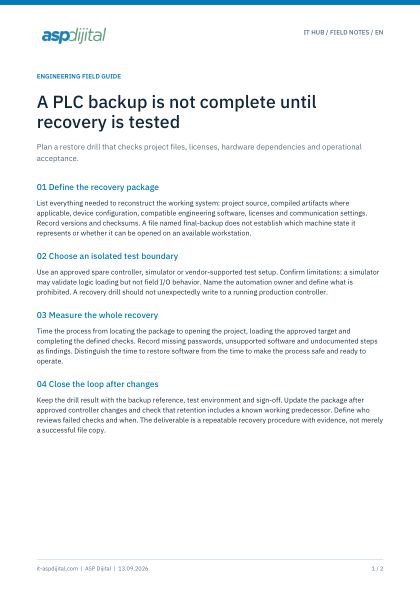
· 2 minPlan a restore drill that checks project files, licenses, hardware dependencies and operational acceptance.
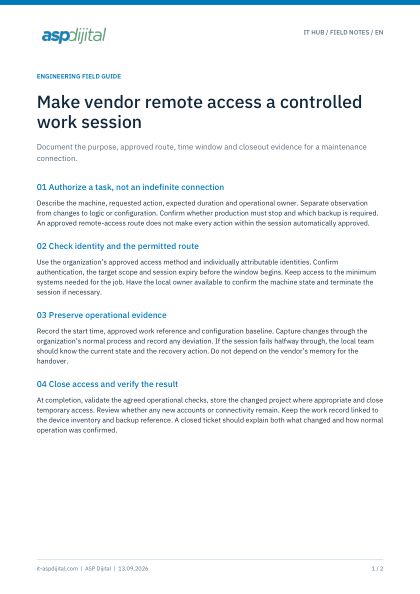
Document the purpose, approved route, time window and closeout evidence for a maintenance connection.
IEC 62443 is the reference framework for industrial cybersecurity. Here is a plain-language map of its parts and how to start applying it.
· 2 minThe Purdue reference model is the backbone of industrial network design. Here is how to map your plant to levels and where the DMZ belongs.
· 2 min
A practical method for sizing OT subnets: how CIDR maps to host counts, how to leave room to grow, how to align subnets with cells and zones and how to document the plan.
· 4 minYou cannot protect what you cannot see. How to build and keep an asset inventory that security and maintenance can both use.
· 2 min
Start with existing evidence, reconcile device ownership and make unknown assets actionable.
· 2 min
How to apply zero trust principles to OT networks without breaking production: start with visibility, segment by zone, broker remote access and verify continuously, within the limits of legacy devices.
· 3 min
Zero Trust is a starting point, not an end state. Real resilience in ICS environments requires detection, recovery, and graceful degradation — not just prevention.
· 3 min
Patterns for giving vendors, integrators and remote engineers controlled access to PLCs and HMIs without exposing them to the internet: brokered sessions, multifactor authentication, time limits and recording.
· 3 min
Document the purpose, approved route, time window and closeout evidence for a maintenance connection.
· 2 min
Hardening a controller is different from hardening a server. Practical, low-risk measures for PLCs and their networks.
· 2 min
The only copy of a machine's logic should never live on a single laptop. A practical backup strategy for PLC programs of any age.
· 2 minPlan a restore drill that checks project files, licenses, hardware dependencies and operational acceptance.
· 2 min
The playbook that protects office PCs does not transfer to controllers. What ransomware actually does to OT and where the defenses belong.
· 2 min
Removable media bypasses every network control you can build. How to manage USB use in OT with a clean station, port control and an audit trail, without crippling workflows.
· 2 min
OT logging is hard because devices log poorly and clocks drift. A practical baseline that satisfies both engineers and auditors.
· 2 min
Unpatched devices are a risk; botched updates are a production outage. A process for firmware that balances both.
· 2 minUnmanaged switches are cheaper; managed switches are controllable. When the difference matters - and when it doesn't.
· 2 min
What Sign and SignAndEncrypt actually change, which security policies to avoid, how application certificates and trust lists work, and the connection errors you will meet first.
· 3 min
Redundant SCADA systems fail in interesting ways. What the standard topologies are and how to test the one you buy.
· 2 minWith a passive asset inventory: document which devices exist, which software versions they run and who owns them. Then address network zones and remote access.
No. They are informational; a site-specific risk assessment and conformity with the relevant standards are separate work.
Let’s look at your machine, your data flow or your production goal together. Describe your situation in a few sentences and the ASP Dijital team will reply by email.