Edge vs Cloud for Industrial Data: A Decision Framework, Not a Religion
Cloud is not always the answer, and edge is not automatically safer. A practical framework for where processing should live.
· 2 minWhere should data be processed, buffered and modeled? These guides compare edge and cloud placement, container-based edge deployments, update pipelines for gateways, observability across IT and OT, and the architecture that connects PLCs, brokers, historians and business systems.
Cloud is not always the answer, and edge is not automatically safer. A practical framework for where processing should live.
· 2 min
What belongs at the edge, how to choose hardware, how to run and update it, and when not to use it: a practical guide for IT teams moving compute closer to the production line.
· 3 min
What containerization looks like on a factory floor: when Docker or Podman is enough, when K3s earns its place, and the pitfalls to plan for, from persistent storage to rollbacks.
· 5 minDefine meaning, timing, quality and ownership so an industrial tag remains understandable outside its source system.
Cloud is not always the answer, and edge is not automatically safer. A practical framework for where processing should live.
· 2 minWhat belongs at the edge, how to choose hardware, how to run and update it, and when not to use it: a practical guide for IT teams moving compute closer to the production line.
· 3 minWhat containerization looks like on a factory floor: when Docker or Podman is enough, when K3s earns its place, and the pitfalls to plan for, from persistent storage to rollbacks.
· 5 min
How to apply continuous delivery practices to industrial PCs and edge gateways without risking production stability: versioned configuration, staged rollout, rollback and shared approvals.
· 3 min
Storing and querying industrial time-series data at the edge requires a different mindset than cloud-native architectures. Here is what works in practice.
· 3 min
How to structure MQTT topics with an ISA-95-style hierarchy, what belongs in the topic versus the payload, how retained messages and last will fit, and which anti-patterns to avoid.
· 4 min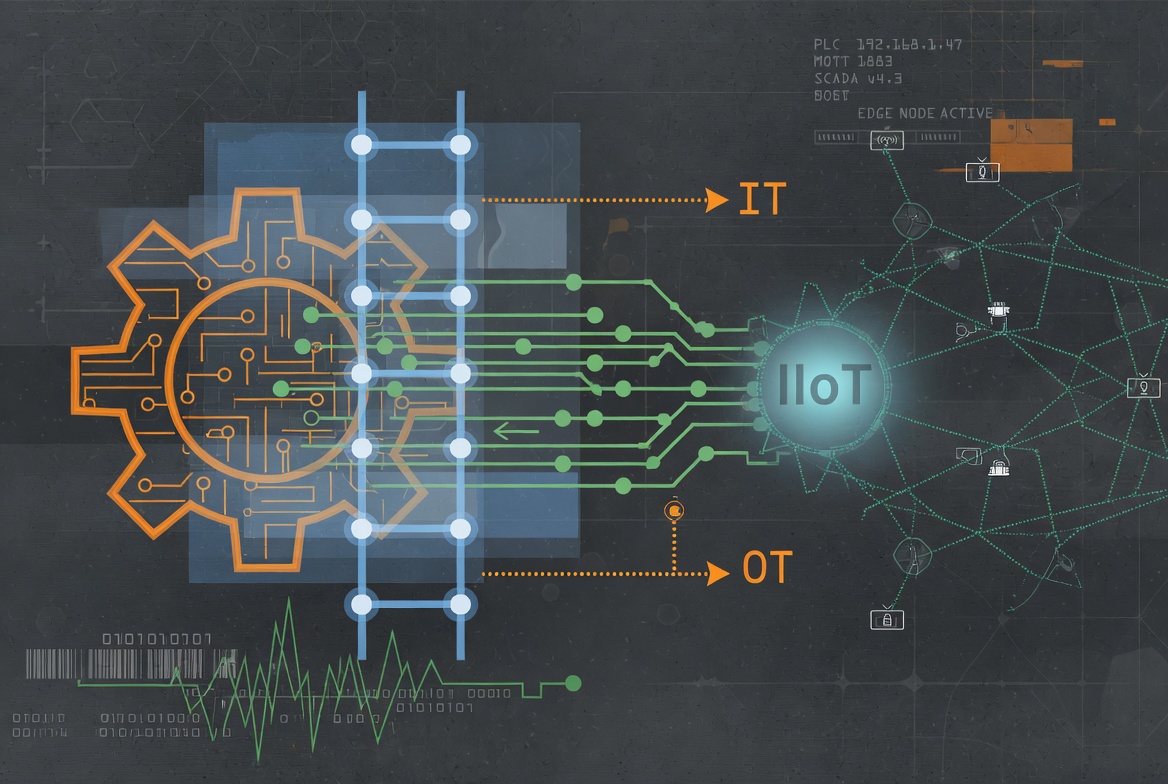
How tag count, sampling interval, payload size, overhead and retention combine into bandwidth and storage numbers, and how deadband and compression change them.
· 4 min
Why timestamps decide whether data can be trusted, where NTP is enough, when PTP is worth the effort, and how to choose a single time source and timestamp convention.
· 4 min
Why and how to run compact machine learning models on edge devices with ONNX Runtime: model export, quantization trade-offs, input validation, local buffering and safe model updates.
· 3 min
A realistic way to start a digital twin: begin with one question about one asset, connect live data, validate the model against reality and assign an owner who keeps it current.
· 3 min
How to build monitoring and alerting that spans IT systems and industrial control networks without drowning operators in noise: the three questions to answer, what to measure and how to design alerts.
· 2 min
Thick clients, Windows workstations and painful upgrade cycles are the usual pain points of classic SCADA. How browser-delivered SCADA changes the architecture, and how to migrate without a big-bang replacement.
· 4 min
The three-letter acronyms blur together, but each layer answers a different question. A clear map of where data originates and flows.
· 2 minWhen you need low latency, tolerance of connection loss, lower bandwidth cost or data that must stay on site. Our decision-framework article covers it in detail.
Pin versions, roll out in stages, test the rollback path beforehand and keep a record of every device’s version.
Let’s look at your machine, your data flow or your production goal together. Describe your situation in a few sentences and the ASP Dijital team will reply by email.